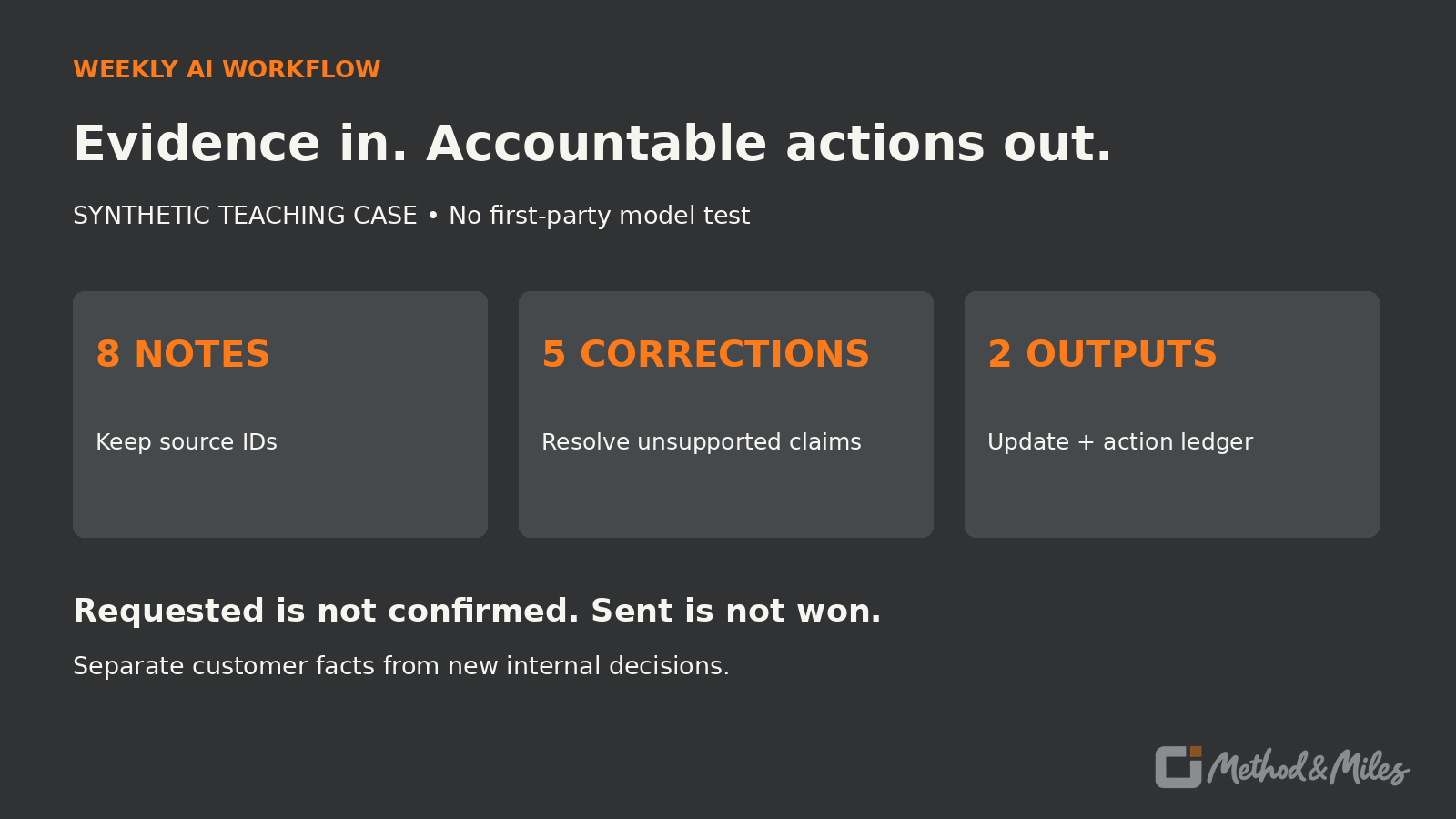
1. Start with the evidence you actually have
The team lead needs next week’s priorities on Friday. A–E, names, money and times are fictional. This is a relative planning week; replace it with real dates in your own records. Keep local timezone labels until participants confirm actual calendar dates.
| ID | Recorded | Item | Source note |
|---|
| N1 | Monday 09:00 | A proposal | Alex: internal estimate is $4,000; no customer approval. |
| N2 | Monday 11:00 | B review | Jordan: customer confirmed Thursday 10:00 ET. |
| N3 | Tuesday 10:00 | A proposal | Alex: quote attachment says $4,400; tax treatment not stated. |
| N4 | Tuesday 16:00 | C follow-up | Casey: no reply. Reason unknown. |
| N5 | Wednesday 13:00 | D handoff | Riley: public overview sent; no purchase decision. |
| N6 | Thursday 08:00 | B review | Jordan: customer requests Tuesday next week at 10:00 ET; acceptance pending. |
| N7 | Thursday 14:00 | E follow-up | Contact next week; owner and deadline missing. |
| N8 | Friday 09:00 | A proposal | Alex: hold approval request until the $4,000/$4,400 conflict is resolved. |
2. Use a bounded prompt and inspect the draft
Only process information your organization permits in the selected account. You can also do the same exercise manually.
Use only N1–N8. For each item, list facts, source IDs, unknowns and a confirmation question. Do not invent approvals, owners, dates or loss reasons. Retain both sides of a conflict. Treat a schedule request as unconfirmed unless acceptance is recorded. Do not calculate revenue.
Illustrative AI-style draft authored to demonstrate errors, not an actual model response:
A is approved for $4,400, B is confirmed for next Tuesday, C was lost on price, and D is won. Jordan will contact E on Monday.
3. Correct claims against the source notes
| Draft claim | Evidence check | Correction |
|---|
| A approved | N1/N3/N8 show no approval and conflicting amounts | Keep both amounts; hold quote |
| B confirmed | N6 records a request only | Mark acceptance pending |
| C lost on price | N4 gives no response or reason | Keep cause unknown |
| D won | N5 records sending a document | Record activity completion only |
| E assigned | N7 contains neither owner nor date | Remove invented fact; make a separate internal assignment |
Verification here means consistency with the supplied fictional notes. It does not mean that customers were contacted or that we measured a model’s error rate.
4. Choose priorities and deliver the final update
Completed weekly update
Five items reviewed. Hold A’s quote until the $4,000/$4,400 discrepancy and approval are resolved (N1/N3/N8). Reconfirm B’s requested move to next Tuesday at 10:00 ET (N2/N6). C remains awaiting reply, with no established loss reason (N4). D’s overview delivery is a completed activity, not a commercial win (N5). E needs an internal owner and confirmed contact date (N7). These notes do not support a revenue forecast or win-rate calculation.
The following owners and deadlines are new internal planning decisions by the fictional team lead, not extracted customer commitments. In a real team, confirm acceptance before assigning work.
| Item | Evidence | Known state | Human decision | Internal owner | Internal target | Next action |
|---|
| A | N1/N3/N8 | Conflicting amounts; unapproved | Hold external quote | Alex | Next Monday noon ET | Confirm tax basis and approved amount in writing |
| B | N2/N6 | Change requested, not accepted | Reconfirm schedule | Jordan | This Friday 16:00 ET | Confirm requested Tuesday time with participants |
| C | N4 | No reply; cause unknown | Do not classify as lost on price | Casey | Next Tuesday noon ET | One follow-up; retain pending status |
| D | N5 | Overview sent only | Record completed activity, not a win | Riley | Next Wednesday noon ET | Confirm receipt |
| E | N7 | External owner/date unknown | Assign internal follow-up responsibility | Team lead | Next Monday 10:00 ET | Agree an internal owner and confirm contact date |
First resolve A’s amount, B’s schedule and E’s missing responsibility. Do not sum the quoted amounts into a forecast: commercial stages, approval and comparability are missing.
5. Reuse the cadence and handle exceptions
Monday: collect changed items. Tuesday: prepare questions for unknowns. Wednesday: separate decisions from open points. Thursday: check conflicting notes. Friday: issue the update and agree the action ledger. These are suggested checkpoints, not proven time budgets or a requirement to use AI every day.
A later correction should receive a new evidence ID and point to the superseded note. Resolve relative dates and timezone ambiguity before sending calendar commitments. If an owner is absent, escalate internally instead of letting the model choose. When source material cannot be uploaded, use the same ledger manually.
Download all eight inputs, corrections, completed outputs and blank rows. The UTF-8 worksheet is static; it does not run a model or sync a CRM. Keep the synthetic examples separate from your own evidence.