

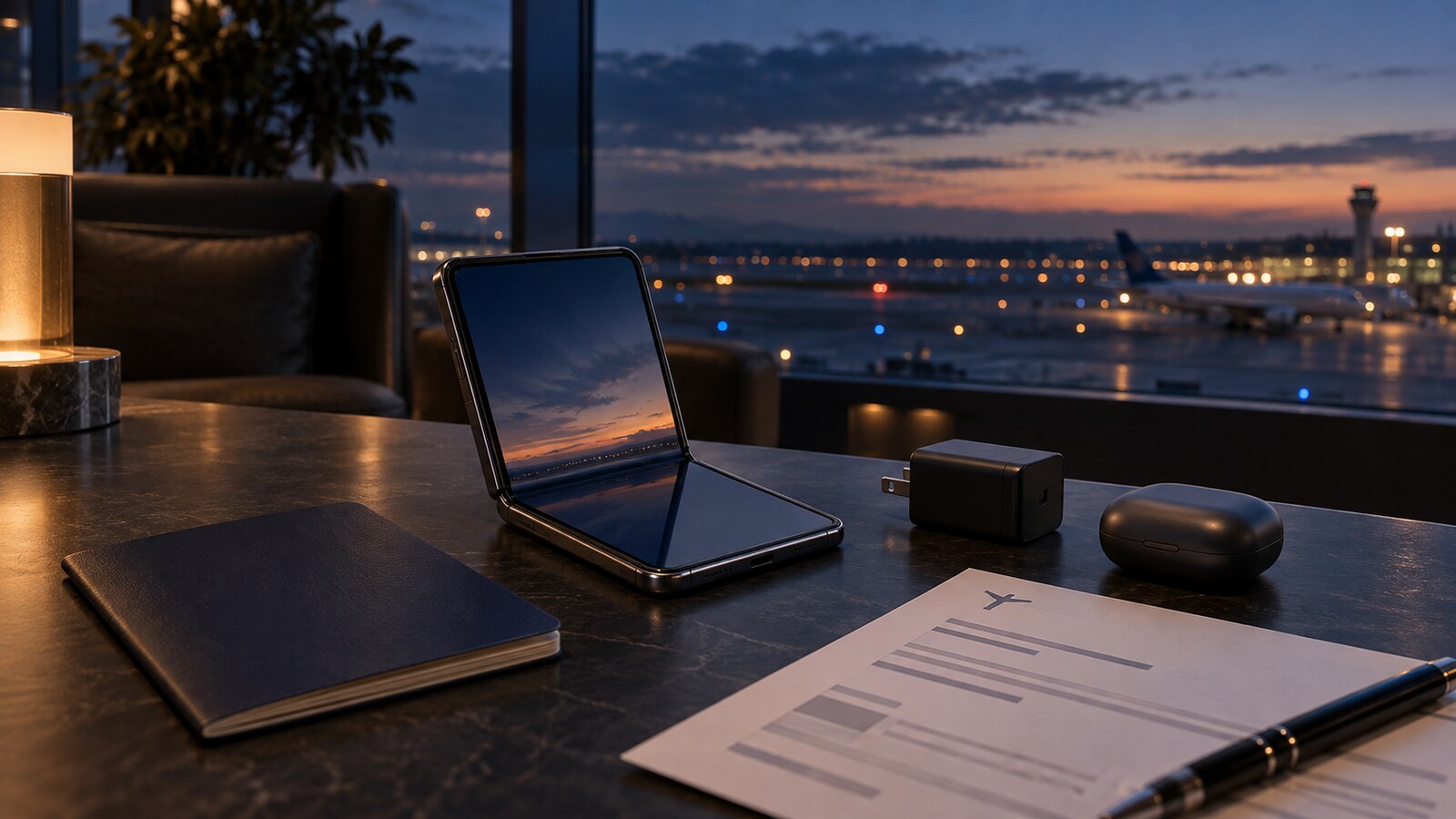
Apple introduced iPhone Duo on September 9, 2026, as its first foldable iPhone. The travel appeal is easy to see: a 7.6-inch inner display, a pocketable 5.4-inch outer display, dual eSIM, long headline battery figures and cameras that can use the second screen as a preview.
But this is still a pre-order decision, not a tested travel recommendation. Apple says U.S. pricing starts at $1,999, pre-orders begin October 16 and availability begins October 23. Real trips will expose questions that launch specifications cannot answer: carrier activation abroad, hinge durability around sand, one-handed use, app behavior and the battery cost of keeping the large display open.
Use the seven checks below to decide whether iPhone Duo solves a real travel problem for you. Do not buy it only because it is the newest form factor.
1. Confirm your eSIM path before you compare anything else
iPhone Duo is eSIM-only worldwide and is not compatible with physical SIM cards. Apple lists two active eSIMs and storage for eight or more profiles. That can be convenient for keeping a home line active while using a destination data plan, but it removes the physical-SIM fallback some travelers still rely on.
- Ask your home carrier whether your number and plan can be transferred to eSIM on this model.
- Confirm that the phone will be carrier-unlocked before relying on a third-party travel eSIM.
- Check eSIM support in every destination, especially if you need a local voice number rather than data only.
- Write down how you will receive bank and account verification messages while the travel line is active.
Apple's travel guidance notes that a destination carrier or worldwide provider must support eSIM, activation may require Wi-Fi, and local identity rules can apply. A worldwide eSIM coverage map is not the same as confirmed service on your exact itinerary.
2. Test the shape and weight against your real carry setup
Apple lists iPhone Duo at 254 grams, 11.3 mm thick when closed and 84.1 mm wide. Opened, it spans 164.6 mm. Those numbers matter more than the word “pocketable” if you walk all day, mount your phone in a rental car, use a compact tripod or keep it in a passport pouch.
Before ordering, simulate the weight with your current phone and a small power bank. Check whether your preferred car mount, MagSafe stand, aircraft seat pocket and running belt can hold the added width or mass. If one-handed map use is central to your trips, the 5.4-inch outer display may matter more than the larger inner screen.
The specifications list grade 5 titanium, Ceramic Shield surfaces and IP68 water and dust resistance. Those ratings do not substitute for evidence about long-term hinge wear, beach sand or repair cost. If those risks define your trips, wait for independent durability testing and published service terms.
3. Model battery life by display, network and charging kit
Apple's battery estimates differ by how the phone is used: up to 44 hours of video playback on the outer display, 31 hours on the inner display and 24 hours of “typical use.” These are controlled claims, not a guarantee for navigation, roaming, photography, hotspot use and poor-signal searching on the same travel day.
| Trip behavior | What to verify |
|---|---|
| Walking navigation | Screen brightness, GPS time and outer-display usability |
| Rail or airport work | Hours spent in Split View on the inner display |
| International roaming | Weak-signal drain and whether two lines stay active |
| Photo and video day | Capture format, uploads and remaining storage |
| Fast top-up | Adapter wattage, cable and outlet access |
Apple says a 60W-capable adapter or higher can reach 50 percent in around 20 minutes by cable, while a 35W adapter or higher plus MagSafe can do so in around 30 minutes. The box includes a USB-C cable, not the required power adapter. Include the charger, cable and any power bank in your total carry weight and cost.
4. Choose it for the camera workflow you will actually use
The rear system pairs a 48MP main camera with a 48MP ultra wide camera. The main sensor also provides a 12MP optical-quality 2x option; Apple does not list a separate long-telephoto camera. That may be enough for food, interiors, street scenes and group photos, but it is a different proposition from a phone built around longer optical reach.
The foldable design offers travel-friendly ideas: the outer display can show the subject a live preview, the phone can stand without a separate tripod, and Dual Capture can record front and rear views. Treat those as workflow options, not proof of image quality. Decide whether you would actually carry less gear or capture a shot you currently miss.
Run a simple comparison when review units become available: low-light hotel room, moving subject, distant landmark, selfie with the rear camera, and a ten-minute propped video. Compare usable files and setup time, not only megapixels or a launch demo.
5. Verify feature availability for each country and language
Apple lists Emergency SOS, Messages, Find My and Roadside Assistance via satellite, but satellite services are not available everywhere. Carrier-provided satellite connectivity is a separate system and may require a supported carrier, plan and country. Neither path should replace a local emergency plan.
Siri AI is also rolling out by language and region, and Apple describes the September 14 release as a beta with usage limits possible. If live translation, itinerary retrieval or visual search is part of your purchase case, verify the exact feature, language, account region and availability before paying.
- Open Apple's feature-availability pages for every destination.
- Check whether your carrier's satellite service is included or separately priced.
- Save local emergency numbers and offline maps independently of the phone.
- Test the feature at home; do not learn its limitations during a disruption.
6. Separate launch-day facts from future promises
Apple says iPhone Duo will ship with iOS 27.1, while Apple Pencil support is described as coming later in the year. Third-party apps can adapt to the foldable layout, but a launch announcement cannot guarantee that every airline, hotel, banking or authentication app will use both displays well.
List the five apps that make or break your trips. For each one, define the behavior you need: boarding-pass brightness, map continuity when folding, password-manager access, camera upload stability or two-pane multitasking. Wait for direct evidence if an app is critical.
This distinction also protects against buying for a future feature. Value the phone using only capabilities confirmed for your purchase date. Treat later software, accessories and regional rollouts as optional upside until they are actually available.
7. Price the trial, not just the phone
Apple's U.S. launch price starts at $1,999 for 256GB. A realistic trial budget may also include a protective case, higher-wattage adapter, MagSafe charger, AppleCare, sufficient storage and any carrier activation cost. Compare that total with keeping your current phone and adding a small tablet, camera or travel power bank only when needed.
If you buy directly from Apple in the U.S., the standard policy allows an eligible return or exchange within 14 days of receipt, in original condition with included parts and packaging. Products bought elsewhere follow that retailer's rules, returns are country-specific, and returning a connected device does not automatically cancel wireless service. Verify the policy that applies to your country and seller before ordering.
Set three decision outcomes: keep, return, or wait for the second generation. During the trial, record eSIM activation time, one-handed comfort, battery remaining after a full itinerary, camera keep rate, app failures and what other gear stayed home. If the fold solves none of those measured problems, novelty is not enough. For the rest of your trip stack, pair this review with the hotel total-price checklist and the Europe border checklist.