1. Compare a stay you would actually book
This guide is for a traveler choosing among three acceptable rooms with different meal, parking and fee arrangements. Reject candidates that fail your required location, bed configuration, accessibility or room conditions before ranking their costs. A cheap unsuitable room is not a saving.
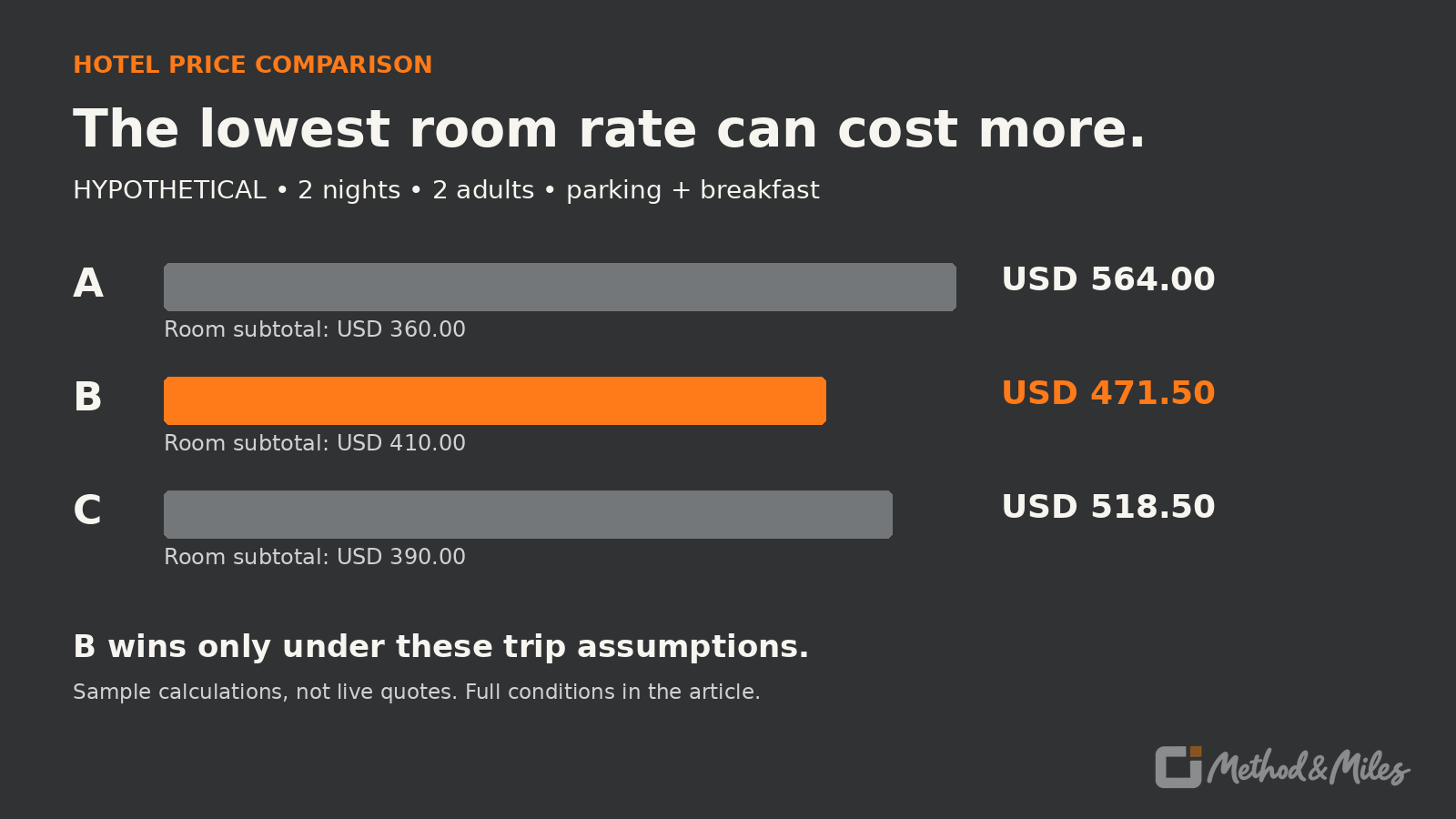
A, B and C are hypothetical quotes, not live hotel prices or first-hand stays. We assume the same dates, two adults, one room, two nights, one car, two breakfasts per person, and USD payment. All three meet the traveler’s minimum room requirements and have the same free-cancellation deadline. The cancellation-rate experiment in section 4 is a separate example.
2. The completed three-quote comparison
Amounts cover the entire stay, not one night or one person. The 15% tax rate is an illustrative assumption, not a stated tax rate for any destination. C requires $30 more in itinerary transport. Costs that would be identical under every choice are excluded.
Hypothetical comparison · two nights, two adults, one room · USD| Cost item | A | B | C |
|---|
| Room subtotal · two nights | $360.00 | $410.00 | $390.00 |
|---|
| Tax not already included | $54.00 | $61.50 | $58.50 |
|---|
| Other mandatory fees · confirmed none | $0.00 | $0.00 | $0.00 |
|---|
| Parking · full stay | $70.00 | $0 · included | $40.00 |
|---|
| Breakfast · two adults, two mornings | $80.00 | $0 · included | $0 · included |
|---|
| Additional itinerary transport | $0.00 | $0.00 | $30.00 |
|---|
| Practical stay cost | $564.00 | $471.50 | $518.50 |
|---|
| Decision | $92.50 above B | Lowest for this itinerary | $47.00 above B |
|---|
A = $360 + $54 + $70 + $80 = $564. B = $410 + $61.50 = $471.50. C = $390 + $58.50 + $40 + $30 = $518.50.
Choose B for these assumptions. Its room subtotal is $50 more than A’s, but the completed itinerary costs $92.50 less. Breakfast and parking are already represented as zero additional spending at B; subtracting their value again would count the same benefit twice.
3. The counterexample: leave the car and breakfast out
For a traveler needing neither parking nor breakfast, A falls to $414, B stays at $471.50, and C becomes $478.50, assuming its $30 itinerary transport cost remains necessary. A is now $57.50 below B. An included meal does not create cash value when you will not eat it.
When the recommendation changes| Condition | Choice in this example | Why |
|---|
| Car and breakfast required | B | $471.50 is the lowest complete cost |
|---|
| No car and no breakfast required | A | $414 is $57.50 below B |
|---|
| B fails a required room/location condition | Exclude B, compare again | Price does not repair an unsuitable stay |
|---|
| Mandatory fee still unknown | Hold the decision | Unknown is not zero |
|---|
Use final stay payment + mandatory charges not in that payment + necessary uncovered options + incremental itinerary transport. If tax, meals or fees are already inside the payment, do not add them again. Keep uncertain points, upgrades and unused credits outside the base cash comparison. A refundable security hold is a temporary cash constraint, not automatically a consumed cost.
4. When paying more for free cancellation makes sense
Consider a separate hypothetical choice for the same room: non-refundable N=$400 or fully flexible F=$440, both including all compared costs. If you travel, you pay the rate. If you cancel before the deadline, N is fully lost and F is fully refunded. There is no cancellation fee, exchange loss, insurance recovery, partial refund or replacement booking in this model.
Let p be your assumed probability of cancelling before the deadline. Expected spending is $400 for the non-refundable rate and $440 × (1−p) for the flexible rate. They tie at p = 1−400÷440 = about 9.1%. Above that assumption, the flexible option has lower expected spending.
Hypothetical sensitivity · cancellation before the deadline| Assumed cancellation probability | Non-refundable expected cost | Flexible expected cost | Lower expected cost |
|---|
| 0% | $400 | $440 | Non-refundable |
|---|
| 5% | $400 | $418 | Non-refundable |
|---|
| 10% | $400 | $396 | Flexible |
|---|
| 20% | $400 | $352 | Flexible |
|---|
This is a transparent model, not a measured cancellation rate or guaranteed saving on one booking. If losing $400 would be unacceptable, liquidity and risk tolerance can justify flexibility even below the threshold. If cancellation is likely after the free deadline, this shortcut no longer applies.
For partial refunds, calculate each rate separately: expected spending = (1−p) × cost if you travel + p × loss if you cancel. Confirm which charges are refunded and the property’s local deadline before using the numbers.
5. What the displayed price does and does not settle
The FTC’s U.S. short-term lodging fee rule took effect May 12, 2025. Known, calculable mandatory fees belong in the advertised total. Government charges and optional extras may appear later, but the final payment amount must include applicable charges before payment is requested. This is a U.S. scope statement, not a promise that every country or seller uses the same rules.
Google’s hotel help explains that rates come from booking partners and can change. Confirm the final price on the booking partner’s page. A search-screen currency selection is not proof of the eventual settlement currency; record the actual payment currency, property-paid charges and any card costs. We do not provide a current exchange rate or a universal card-fee assumption.
6. Take the completed result into your next booking
Download the filled example and blank comparison rows (CSV). The A/B/C inputs, totals and decisions are already filled. Three additional rows are ready for your own quotes. This is a worksheet, not an automatic calculator: recalculate the total when inputs change and leave unknown amounts blank.
Completed decision record: two adults, two nights, car and breakfast needed → comparable cancellation conditions → totals $564/$471.50/$518.50 → choose B → switch to A if neither parking nor breakfast is needed. The result and the condition that reverses it belong together.
For an actual booking, record the observation time, booking URL, room conditions, payment currency, final payment, property-paid extras, inclusions, cancellation deadline and timezone, and loss on cancellation. Save the final total, currency and cancellation wording before paying. Count a member, mobile or coupon rate only if you personally qualify. Any material mismatch sends the quote back for comparison.