1. Define a completed task before comparing plans
This guide serves a personal user repeating email, document and meeting-note tasks. It answers whether to keep a free plan or trial one paid plan; it does not rank ChatGPT, Gemini and Claude as universal winners. All sample times and dollar amounts below are invented teaching inputs, not current vendor prices.
| Task | Comparable completion test | What a paid plan must change |
|---|
| Email rewrite | A ready-to-send reply that preserves meaning and meets a 100-word limit | Nothing, if free already completes it reliably |
| Document summary | Five claims mapped to source pages; uncertainties retained | The specific upload or capacity problem, not merely a larger marketing number |
| Meeting actions | Decisions, unknowns, owners and dates without invented commitments | Completion under the same deadline and review standard |
Use the same input, output standard and deadline for each candidate. Workplace data requires an approved account and permitted data use; a personal subscription does not confer organizational permission.
2. Compare the constraint, not unlike message counts
| Service | Official evidence checked October 1, 2026 | Account-level verification still needed |
|---|
| ChatGPT | File, image and analysis tools can have limits distinct from everyday chat | Which tool blocked the task, the in-product reset notice, and relevant paid access |
| Gemini | Usage depends on compute factors; personal-account guidance differs from work/school access | Account type, Usage Limits screen, and availability of the required feature |
| Claude | Usage over time and the length of one conversation are separate constraints; extra paid usage may add charges | Which constraint you hit, additional usage settings, and spending exposure |
These are constraint categories, not measured quality or speed scores. Record the checkout price, currency, tax, billing period and renewal terms for your own account. A missing price or untested paid capability stays unknown.
3. A filled seven-day example, with an explicit denominator
Synthetic log, not an observed product test. Each row counts attempted tasks. “Completed” means accepted without a quota interruption. Extra minutes are only rework and switching caused by interruption; ordinary editing and review are excluded to avoid counting them twice.
| Day | Task | Attempts | Completed | Extra minutes |
|---|
| Mon | Email rewrite | 1 | 1 | 0 |
| Tue | PDF summary | 1 | 0 | 25 |
| Wed | Meeting actions | 2 | 2 | 0 |
| Thu | PDF summary | 2 | 1 | 20 |
| Fri | Email rewrite | 2 | 2 | 0 |
| Sat | File comparison | 2 | 1 | 15 |
| Sun | No task | 0 | 0 | 0 |
The total is 10 attempts, seven uninterrupted completions and 60 extra minutes: 70% completion and one hour of interruption overhead. Sunday has no attempt, so it adds no failure. Repeating this pattern for four weeks gives four hours; that is a scenario assumption, not a measured calendar month.
4. Calculate a paid threshold and a counterexample
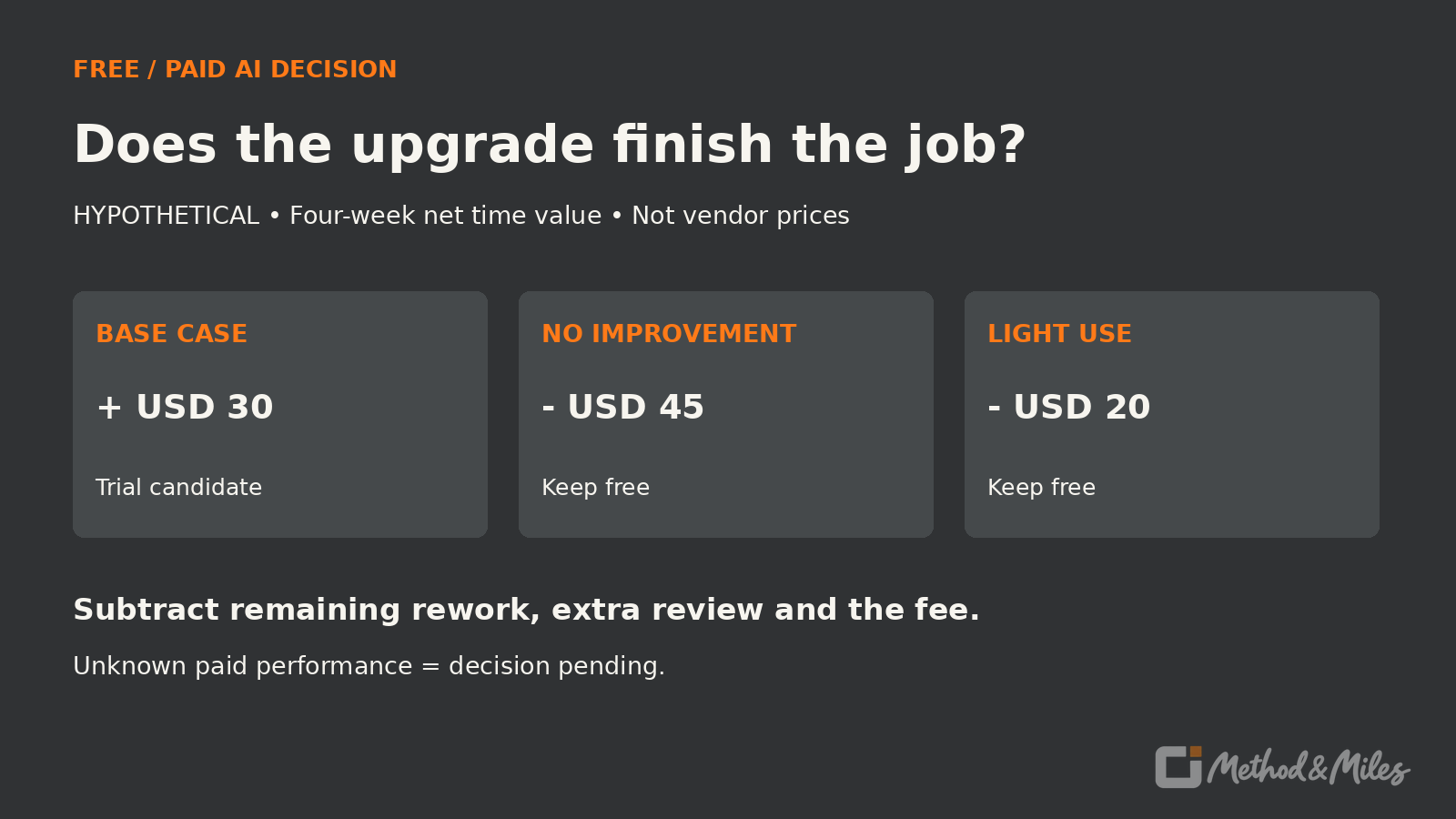
Net time value = (free overhead − remaining paid overhead − incremental paid setup/review) × chosen hourly value − incremental payment. Time value is not cash earned. Keep ordinary review in both plans; count only its difference here.
| Four-week hypothetical case | Free hours | Paid hours | Extra review/setup | Net at $25/hour and $20 fee | Decision |
|---|
| Base case | 4 | 1 | 1 | (4−1−1)×25−20 = +$30 | Candidate for one billing-period trial after capability check |
| No improvement | 4 | 4 | 1 | (4−4−1)×25−20 = −$45 | Keep free or stop renewal |
| Light use | 1 | 0.5 | 0.5 | (1−0.5−0.5)×25−20 = −$20 | Keep free |
The base case breaks even at a $50 fee. With the assumed $20 fee and one incremental review hour, the reduction in rework must exceed 1 + 20÷25 = 1.8 hours over four weeks for a positive result. At exactly 1.8 hours the net is zero. An untested paid plan has unknown remaining overhead: the base case is a test target, not permission to declare savings.
5. Apply exceptions and reuse the worksheet
At a zero hourly value, time alone cannot recover the fee. An urgent deadline or accessibility need can matter separately, but do not call that revenue. Include tax and usage credits; compare employer-provided access before buying another subscription. Annual billing adds commitment and refund risk, so a monthly equivalent is not a complete cash comparison.
Download the filled log, three scenarios and blank recording rows. This UTF-8 CSV is a static worksheet, not an automatic calculator. Keep synthetic rows separate from your observations. Unknown inputs remain blank and block a numeric decision.
For the earlier choice of which tool fits the job, see how to choose AI tools. For a completed weekly output after choosing a tool, see the weekly AI workflow example.